The Republic Museum is worth visiting when you want to understand Ankara as a political capital, rather than only as a base for ancient sites. Its strongest feature is the former parliamentary setting. Be sure you choose the correct building: the Republic Museum occupies the Second Grand National Assembly, while the nearby First Assembly is the separate War of Independence Museum. [1] [2]
Start with the distinction between the two assemblies
The First Assembly building served the founding parliament between 1920 and 1924. The Second Assembly, now the Republic Museum, opened for parliamentary use in October 1924 and represents the next stage in the republic's institutional history. They are complementary, but they are not two names for the same museum. [2] [1]
That distinction determines which visit to prioritise. Choose the First Assembly when the independence struggle and the founding parliament are your main interests. Choose the Republic Museum when you want to see the setting associated with the developing republic and its subsequent political life. Visiting both is useful when you have the time and attention to compare them.
Avoid treating the pair as a single ticketed complex without confirmation. They have different institutional arrangements, and an opening notice, admission rule or group booking for one should not be transferred to the other. Save the Turkish name "Cumhuriyet Müzesi" and the description "II. TBMM Binası" with your map pin.
For a first visit to Ankara, the museum helps explain why the city matters beyond its best-known monuments. It gives the capital's political identity a physical setting rather than leaving it as a line in a guidebook.
Give the assembly chamber your attention
The chamber is the natural centre of the visit. The Culture Directorate identifies it as the room where Atatürk delivered the lengthy speech known as Nutuk in October 1927. Seeing a place where political communication occurred can make the history easier to grasp than reading a sequence of dates alone. [3]
Begin by looking at the room's arrangement: the relationship between the speaker, the seats and the surrounding spaces. Ask how the architecture supported an institution rather than viewing it only as an attractive interior. A few minutes of deliberate observation can make the rest of the displays more meaningful.
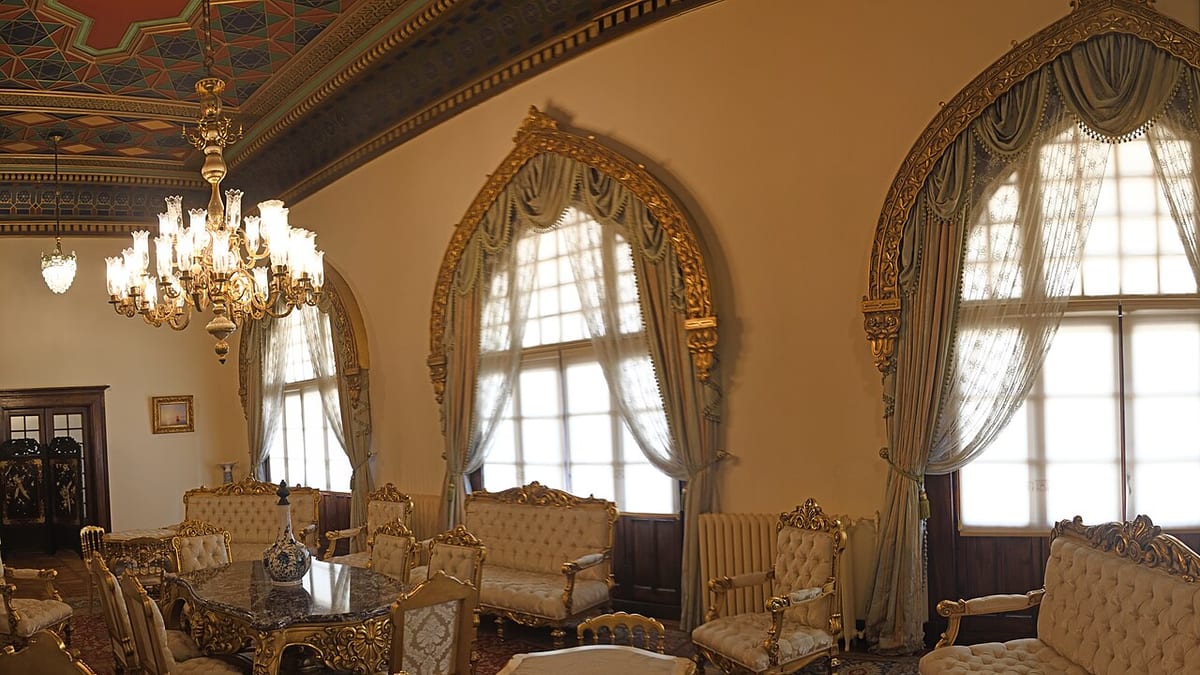
The building was designed by Vedat Tek, and the official description draws attention to its decorated wooden ceilings, arches, tiles and other architectural details. These are worth noticing even for a visitor who has limited prior knowledge of Turkish political history. [1] [3]
Do not rush straight from the entrance to the best-known photograph position and then leave. The smaller rooms help connect the formal chamber with the people and administration behind it. A compact museum can still reward a slower, selective visit.
Personal objects need context
The collection includes material associated with the first three presidents: Mustafa Kemal Atatürk, İsmet İnönü and Celal Bayar. The useful approach is to connect objects and photographs to changes in public life, rather than treating a display of possessions as automatically self-explanatory. [3]
Before going, learn a brief outline of the transition from the independence period to the early republic. You do not need an academic history course. Knowing which institution occupied which building, and roughly when, is enough to stop names and dates becoming an indistinct list.
For an English-speaking visitor, do not assume that every label or available audio option will provide the same depth in English. Ask about the current language provision at the entrance. A guide can be worthwhile when you want discussion, but a guided city tour should name this museum explicitly rather than merely promising "Ankara history."
For families, choose one tangible theme. Compare the chamber with a modern parliament seen on television, or ask what an object reveals about official work. Trying to explain every political development to a child in one visit is unlikely to improve anyone's experience.
Plan a daytime visit and leave room for uncertainty
Official pages do not present a fully consistent set of current opening hours. The museum portal and the Culture Directorate display different schedules, while a separate winter notice explicitly applies to 2025–2026 rather than the coming winter. It would be misleading to select one closing time and label it universally current. [1] [3]
The practical solution is to plan the museum for late morning or early afternoon and confirm the day's final entry time when needed. This avoids making the success of the visit depend on an uncertain last hour. It is particularly useful around the seasonal change at the beginning of November.
Likewise, buy admission through the current official arrangement rather than relying on an old travel-blog price. The national museum portal's mention of Müzekart does not establish that every foreign visitor or every tourist museum pass qualifies. Tell the ticket desk which pass and eligibility category you actually have. [1]
I would initially allow about an hour, with more time for detailed interpretation or a combined First and Second Assembly visit. That is a suggested allocation, not a measured average. A short visit can still be worthwhile when it is focused, while a hurried final-entry dash is less likely to give the chamber and displays their due.
Fit it into Ulus without exhausting the day
The Republic Museum is on Cumhuriyet Boulevard in Ulus. This makes it a logical part of a historical-city day, but it should not become one of several museums visited consecutively without a break. [1]
A useful plan is to choose one assembly museum first, pause for lunch or a walk, then decide whether the second adds something you still want to understand. Travellers with a deeper interest in political history can reverse that emphasis and make the two institutions the main purpose of the day.
Visitors with mobility requirements should ask about the entrance, the chamber route and any current restrictions before arranging a tight transfer. A historic building's modest size does not by itself establish easy step-free access.
The Republic Museum is most rewarding when its subject is your reason for entering. It is less likely to satisfy someone seeking a large archaeological collection or a spectacular city panorama. Choose it for the parliamentary space, the early republican story and the chance to compare institutions - not simply because it appears on a list of Ankara sights.