Anıtkabir is worth visiting for an introduction to the Turkish Republic, even if military history is not your main interest. The experience combines monumental architecture, a national place of remembrance and a substantial museum. Give it a proper part of the day rather than treating the mausoleum as a quick photograph, and choose an ordinary date when quiet exploration matters most. [1] [2]
What makes the visit different from a conventional museum
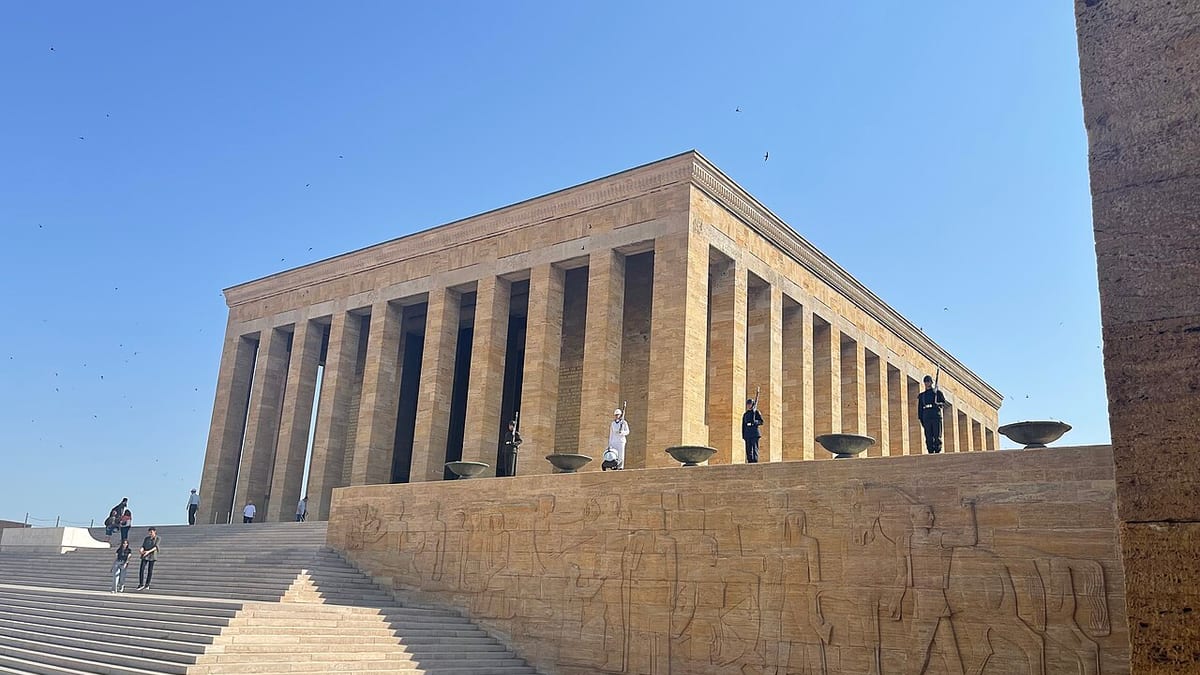
Anıtkabir is the mausoleum of Mustafa Kemal Atatürk, the Republic's founder. Its approach, ceremonial space and Hall of Honour are integral to the experience, not simply a route to a display case. The Ministry of Culture describes the complex's construction and carefully planned architectural sequence. [1]
That makes it a particularly useful stop for understanding why Ankara matters beyond its transport connections. You do not need to know every episode in twentieth-century Turkish history before arriving. It helps, however, to recognise that other visitors may be paying their respects rather than sightseeing casually.
For an architecture-focused visitor, allow yourself to notice the changing scale: the approach, the open ceremonial area and the enclosure of the principal building. For a history-focused visitor, preserve enough attention for the museum instead of using all your energy outside. These are different ways of enjoying the same place, and neither requires racing through every section.
The experience is less suitable as an improvised stop between a late lunch and an imminent train. There is a meaningful amount of outdoor movement before you have finished even a selective visit. A rushed arrival risks reducing a complex national memorial to its most recognisable façade.
The museum is a reason to go, not an optional afterthought
The Atatürk and War of Independence Museum includes personal belongings, historical panoramas, galleries about the national struggle and reforms, and material from Atatürk's library. The provincial tourism authority identifies the National Pact Tower as the museum entrance. It also specifically describes Turkish and English explanations in the section covering events from 1919 to 1938; that is not a promise that every label throughout the complex is bilingual. [2]
A useful way to approach the displays is to choose a question. How did the Republic take shape? How does the memorial present Atatürk's public and private life? What does the architecture communicate about remembrance? A question gives the objects and historical scenes a connection that a checklist of rooms cannot.
The displays represent an official national narrative. Read them with that purpose in mind, especially when comparing the visit with broader historical reading. Understanding the institution's perspective does not diminish the value of seeing how the country commemorates its founding.
With children, select a few tangible objects or visual scenes rather than demanding attention to every explanatory panel. Discuss what a memorial does and why people behave differently here than in a playground. A shorter, attentive visit is preferable to an exhaustive circuit that ends in fatigue.
Hours, admission and the time to allow
The Command's ordinary visiting schedule changes seasonally. From 1 November through 31 January it lists 09:00–16:00; from 1 February through 14 May, 09:00–16:30; and from 15 May through 31 October, 09:00–17:00. The site is listed as open daily. Special commemorative arrangements are announced separately. [3]
Recent Turkish visitor guidance confirms that admission is free. A private guided tour may charge for guiding and transport, but that should not be confused with buying ordinary entrance to the memorial. Ask any tour operator to separate those services in its description. [4]
My planning recommendation is to protect roughly two to three hours for a first visit, including the approach and a selective museum visit. That is an itinerary allowance, not a measured average or an official minimum. Readers who examine every display may need longer; visitors interested mainly in architecture may choose a shorter circuit.
Do not interpret the closing time as a sensible arrival time. For a winter visit, a morning or early-afternoon start gives you room to slow down. Leaving the entire stop until the last hour creates an avoidable choice between the outdoor memorial and the museum.
Getting there without making the approach harder
EGO lists Anadolu/Anıtkabir on the Ankaray route, which also serves Kızılay and AŞTİ. It is a useful station to investigate when planning the trip, but a station name is not a guarantee that its exit delivers you directly to the security entrance. Map the remaining approach to the entrance being used that day. [5]
A taxi can be helpful when walking distance is the limiting factor. Explain that you need the visitor entrance rather than merely a viewpoint near the complex. For a group, agree on the return meeting place before separating, and keep the hotel address available in writing.
The education ministry's venue guidance identifies accessibility provision and an advance-arranged group guiding service. Travellers requiring step-free access should obtain the practical route from the site rather than assume the ceremonial approach is the only option. Advance group guiding is not the same as a guaranteed walk-in English tour for an individual visitor. [6]
Comfortable footwear and a manageable bag make the outing easier. Keep the plan simple enough that a longer entrance procedure would not cause a missed booking elsewhere. For an older relative, preserve energy for the section they most want to see instead of insisting that everyone follow an identical route.
Ordinary sightseeing or a commemorative day?
Choose an ordinary day for the best chance of concentrating on the displays and architecture. Choose a major commemorative date because you want the civic atmosphere, accepting that your sightseeing priorities may have to change.
Republic Day illustrates the distinction. For 29 October 2026, the Command announced public access after the official ceremony until 22:00. That was a specific, now-completed holiday arrangement - not a general evening opening policy and not a confirmed timetable for 2027. [7]
A ceremony-focused visit and a detailed museum visit do not have to happen together. During a longer stay, separating them can be more satisfying than trying to absorb the displays while watching the clock for a public event.
How to fit Anıtkabir into a short Ankara stay
Make it the principal activity of a morning or afternoon, then add a meal and one lighter stop. Avoid combining it with several distant attractions simply because each looks modest on a map. The value comes from having enough attention to understand what you are seeing.
For someone who mainly wants shops, nightlife or an easy café afternoon, Anıtkabir may not be the most immediately entertaining stop. For someone asking what distinguishes Ankara from another large city, it is a strong choice. Visit for the relationship between public memory, architecture and modern history, not merely because it appears on every highlights list.
The most rewarding plan is straightforward: arrive with time in hand, take the approach seriously, choose a manageable museum route and leave without forcing a second major outing onto the same remaining hour. That gives the memorial room to be more than a photograph.
Sources
- Ministry of Culture and Tourism: Anıtkabir
- Ankara Culture and Tourism Directorate: Atatürk and War of Independence Museum
- Anıtkabir Command: ordinary visiting hours
- ENUYGUN: Anıtkabir visitor guide
- EGO: Ankaray A1 route and stations
- Ministry of Education: Anıtkabir learning venue
- Anıtkabir Command: 29 October 2026 public opening notice