Ankara's Ethnography Museum is worth visiting for traditional arts, craftsmanship and the ways objects express everyday life, belief and status. It is a different experience from the Museum of Anatolian Civilizations. A newly opened temporary exhibition adds a specific reason to visit in late 2026, while the building's role as Atatürk's temporary resting place gives it another layer of significance. [1] [2] [3]
Choose it for objects you can examine closely
The museum's collections include woodwork, manuscripts, ceramics, textiles and metalwork. Rather than trying to remember every category, choose two or three that interest you and give them sustained attention. The official gallery descriptions make clear that the collection is not limited to a single kind of traditional costume or household display. [1]
Wooden architectural elements are a strong starting point. A door, ceiling detail or carved furnishing invites questions about the building it originally belonged to, the skill required to make it and the reasons it was preserved. Looking closely at joins, repeated patterns and traces of use can be more rewarding than reading labels at speed.
Then contrast that material with something made for a different purpose, such as ceramics or a manuscript. Ask how portability, fragility and intended audience changed the design. These are ways to engage with the collection, not a requirement to arrive with specialist knowledge.
The museum suits visitors who enjoy slowing down around objects. Someone primarily looking for monumental ruins, broad ancient chronology or outdoor views may prefer another Ankara attraction. The word "museum" alone does not make the city's different collections interchangeable.
The temporary exhibition is genuinely dated
The Ankara Culture Directorate confirms that "Traces from History: Turkish Hearth Cultural Heritage Exhibition" opened on 22 October 2026 and is scheduled through 29 October 2027 in temporary exhibition hall nine. It brings together seventy selected objects, fifty-two of them being shown for the first time. [2]
That is a meaningful addition for a repeat visitor, not merely a generic claim that there is always something new. The exhibition draws on a collection received by the museum in 1978 and explores cultural life through material such as dress and handicrafts. [2]
For a first visit, do not let the temporary display consume all your time simply because it is new. Choose a route that includes a few permanent galleries, then use the exhibition to deepen or complicate what you have already seen. For a return visit, it may reasonably become the main reason to come back.
The scheduled end date is a programme announcement, not a guarantee against all later operational changes. Nevertheless, it is a firmer basis for planning than an undated social-media photograph. Use the exhibition title when asking about access, particularly when travelling specifically to see it.
Understand the Atatürk connection without confusing the sites
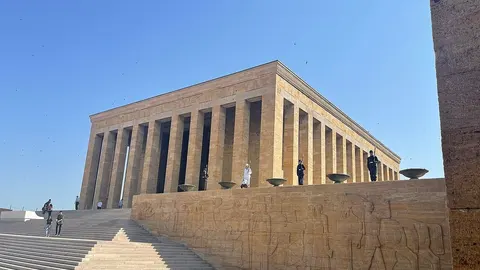
The museum served as Atatürk's temporary resting place between 1938 and 1953, before his remains were transferred to Anıtkabir. The commemorative area inside therefore reflects an actual chapter in the building's history, not simply a decorative tribute added to an unrelated collection. [3]
The two sites answer different questions. Anıtkabir is the mausoleum and major national memorial; the Ethnography Museum combines its own collections with the memory of the intervening period. Visiting the museum does not replace a visit to Anıtkabir when the memorial is your principal interest.
Allow the change in tone to be part of the experience. A gallery of crafts encourages close observation of material and technique; a commemorative space invites reflection on the building's public role. There is no need to turn both into a hurried photographic sequence.
For visitors unfamiliar with the history, a short explanation beforehand helps. Keep the chronology simple and accurate: a museum building, a temporary resting place, then a return to its museum role. The Culture Ministry's English-language material offers a useful introduction without requiring a lengthy detour into every architectural or political detail. [4]
A practical route through the collection
Start with a gallery that immediately interests you, rather than feeling obliged to study everything equally. Follow it with a contrasting material, then the commemorative area and temporary exhibition. This creates a sequence of different kinds of attention instead of one long run of similar display cases.
For example, a visitor interested in design might begin with carved wood, move to ceramics and finish with textiles. Someone interested in writing could give more time to manuscripts and the objects associated with calligraphy. The official gallery descriptions support both approaches. [1]
Take notes on a few objects rather than photographing every case. Record what you want to learn later: the technique, place of origin or unfamiliar term. A small number of specific questions is more useful than a phone full of images with no context.
For a family, ask each person to choose one object and explain what they think it was made to do. Compare the guesses with the interpretation. This keeps the visit active without inventing a scavenger hunt that requires touching displays or entering restricted spaces.
Time, opening hours and the surrounding day
The Culture Directorate publishes winter hours of 09:00–17:30, with the ticket office closing at 17:00; its summer schedule runs later. It also notes a different opening arrangement on the first day of religious holidays. Those conditions are more useful than a blanket statement that the museum is open at the same time every day of the year. [1]
Allow roughly ninety minutes as an initial planning choice, then adjust to the temporary exhibition and your interest in the permanent galleries. This is editorial guidance, not a visitor-time statistic. A specialist could spend longer, while someone combining several museums may deliberately select fewer rooms.
Do not assume that the neighbouring cultural buildings share the same opening status. A closure notice for another museum is not evidence that the Ethnography Museum is closed, and an old one-day closure is not a permanent shutdown. Use the institution's own current notice when a particular date matters. [5]
The museum is on Türkocağı Street in the Opera area. Plan the approach and any step-free requirements around the actual entrance, not merely a broad map label. Leave space for a break before another collection-heavy visit. [1]
Choose this museum when you want to understand culture through things people made, used and valued. Its scale rewards selective attention, and the confirmed temporary exhibition gives that visit a current focus without turning the whole article - or the whole afternoon - into a search for novelty.